
Overview
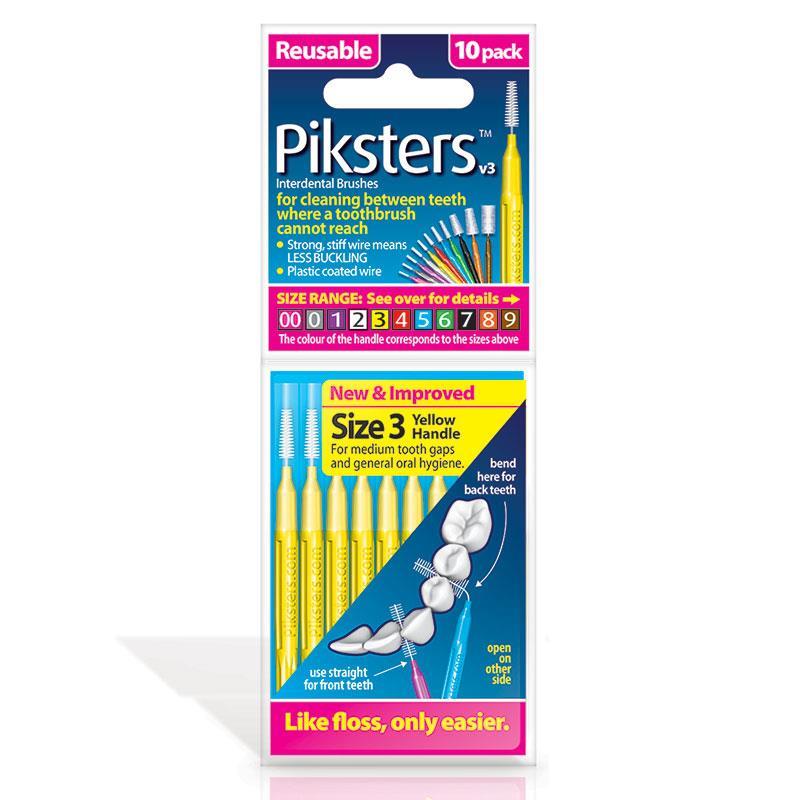
Piksters Interdental Toothbrushes – Size 3 Yellow (10 brushes per pack)
Piksters interdental brushes represent great value. Each brush has a strong plastic-coated wire and nylon bristles.
The unique swivel handle doubles as a protective, hygenic cap.
Piksters interdental brushes are easy to use and are colour-coded for ease of recognition.
Available in straight or taper.
Piksters are interdental brushes.
The following is general information about interdental brushes and how they relate to gum disease and oral hygiene.
What are interdental brushes and where are they used?
Interdental brushes are small circular toothbrushes that you insert into the spaces between your teeth to clean the difficult areas. They are generally used for normal cleaning, sometimes as an alternative to floss and sometimes as an adjunct to floss. They are much easier to use, especially under bridges and around implants. They can also be used under orthodontic wires or between splinted teeth that can’t be flossed and anywhere a toothbrush cannot reach.
But I brush my teeth … why do I need to clean the space between my teeth?
Although the space or gap between your teeth conceals only about 40% of the tooth surface, it accounts for about 80% of the problems. By cleaning the space you get a huge and disproportionate advantage in stopping decay and gum disease. Problems in the space can be serious because they often go unnoticed. This is the reason most X-rays are taken – to check for decay in the space and to catch it early. By cleaning the gap, you not only reduce your chance of dangerous decay, root canal treatments and crowns, but you substantially reduce your chance of serious gum and bone disease around the chewing teeth.
Is gum disease really that serious … don’t the gums just heal?
The gum itself is not the problem or the issue. The gum merely covers the bone and the bone is what holds your tooth in. When the gum gets inflamed and infected, it slowly eats away the bone… because this is not painful a lot of people don’t even notice it happening and may not know until it is almost too late to save the tooth.
How do I tell if my gum is inflamed or infected?
If your gums are unhealthy they will often bleed when you brush them. Another early warning sign is to see if the gum bleeds on gentle probing by the dentist or hygienist. if this occurs do not stop brushing your teeth. It is critical that the gum doesn’t get infected or inflamed for long periods. Interdental brushes will stop the gum bleeding with time by removing the cause, which is the ‘plaque’. Get your gums checked every 6 months to assess what state they are in.
What about floss? How does it compare to interdental brushes?
Floss is an excellent way to clean the gap and if you already floss you should definitely not stop. The problem is that most people don’t floss…probably because they find it too awkward to use. Interdental brushes can be used with one hand, which makes them easier and more likely to be used. Floss is superior in some areas…such as the front teeth. It gets down under the spike of gum in between the teeth. But in other areas, interdental brushes may be better, such as the indents (or hollows) between the roots of your molars and premolars. These areas are called ‘furcations’. Floss forms a straight line across the top of the furcation, whereas interdental brushes have bristles under compression that spring out sideways to clean these hollows. Gum disease and decay between the back teeth is a bigger problem than in the front teeth…as evidenced by the millions of people who have many missing back teeth but still have their front ones relatively in tact. Interdental brushes address the most important issue, the back teeth, and make effective cleaning easier and more likely to happen.
Are interdental brushes only for unhealthy or inflamed gums?
No, they can be used for daily plaque control on healthy or inflamed gums in conjunction with your normal toothbrush. They are also an excellent aid for those who wear orthodontic wires or teeth that are splinted (wired together) for orthodontic retention or for periodontal support, because they clean between the teeth under the wires where it is hard to get floss. Implants need special care, as do bridges. Plastic coated interdental brushes are very good for these areas as they can clean around the artifical teeth without damaging them, and are quick and easy to use. Floss needs an awkward floss threader to use around bridges and splinted teeth.
What size should I use?
You can ask your dentist or hygienist what size/s they would recommend. Alternatively, you can often buy a variety pack with one of each size so you can experiment to see what size fits most comfortably into the various spaces you have in your mouth. Insert the smallest size first and keep using a bigger size until the brush fits snugly between the teeth without forcing it. This allows for a thorough cleaning action and suppresses the gum from growing up excessively in between your teeth. Excessive growth can cause a natural food and plaque trap which lead to a self degenerating situation.
Do I use the biggest size I can get between my teeth?
Generally speaking, use larger sizes for back teeth and the small ones for the front teeth. For back teeth, use the biggest size you can comfortably get in as it will provide a more thorough cleaning action and suppress the gum from growing up excessively in between your teeth. Such excessive growth can cause a natural food and plaque trap which leads to a self degenerating situation. IMPORTANT – Please Note: All interdental brushes, toothpicks and sticks can put pressure on the tip of the gum, especially if you force it, or use a brush that is too big for the space. This can cause a slight re-shaping of the gum over time. This is generally good for back teeth but most people like the look of the small triangle of gum growing inbetween their front teeth. Therefore, use the smallest size around your smile area in order to ensure a gentle cleaning action on these cosmetically sensitive areas, or if in doubt use floss instead. Note that you will do no harm if the gum reshapes slightly – it is just a minor cosmetic issue. If you are not worried about the cosmetics, use any size that you can comfortably get in between your teeth. Caution – Although you can bend the wire for easier access into back teeth areas, do not bend the wire back and forth too often as it will weaken the wire and eventually cause it to break…sometimes in as little as 5 bends. If it does break and leave the brush piece in between your teeth, use your fingers to remove it or use another brush to push it out.
How long do interdental brushes last?
Generally in a range of 3 days to 2 weeks, depending on which brand you use and how hard you work it.









Reviews
There are no reviews yet.